
A Performance Mind: Is Your Mind a Friend or Foe?
Knowing how to manage your mind during setbacks can be the subtle shift you make that boosts your performance to the next level.


A basic truth in life is that the things we care about deeply have the greatest ability to hurt us. This is true whether it is in relationship to another person, sport, career, or any other passion. If you don’t genuinely care about something (or someone) it can’t break your heart. The paradox at the core of love and pain is undeniable: they are interconnected and inseparable. And yet, to disconnect and not care at all is not a desirable or healthy path. In my seventeen years as a psychotherapist, I’ve never once had someone tell me their goal is to live an apathetic life. Apathy is the absence of emotion, the absence of feeling and care. It is an emotional void. Most people who experience chronic apathy seek counselling because they feel tormented by a lack of feeling, often in the form of what we clinically refer to as major depressive disorder.
To care means to take risk, to invest emotion, time, attention, energy, with the hope of gains. This process is scary because when we invest and we lose, it hurts. But there are different kinds of hurt. Senseless hurt and hurt with a purpose. Experiencing growth-related hurt in pursuit of something we care about is meaningful, it is not senseless. It is also almost always inevitable as we evolve and calibrate our plan, performance, and path along the way. Choosing what (or who) we love and how we go about nurturing that relationship matters in our gains and losses. Part of nurturing the relationship is to normalize and make space for setbacks, for hurts, for stumbles, falls, missteps and failures along the way.
Experiencing growth-related hurt in pursuit of something we care about is meaningful, not senseless.
As humans we are wired to seek the path of least resistance. And, in my lifetime, I have watched the world evolve to become more accommodating to the “easy” life. I am old enough to remember the invention of the internet. The smart phone. Social media. And while these technologies have brought us many positive outcomes, they also make it easy to be disconnected from what we care about – taking time to invest in something deeply is hard work, getting a quick hit of dopamine from social media is easy.
I highlight this because I see many people seek therapy when they care deeply and their heart gets broken – a failed test, a break-up of a romantic relationship, a DNF in an important race. These situations break our hearts because we dared to care, to try, and our outcome came up short of our hopes and dreams. This Fu*king hurts, there’s no way around it. And… it’s not the end of the story. Not if we step back and zoom out and see that this is part of it – the hurt, the pain, the reflection, learning, recalibration – these are part of the care and love of a good life.
Make your mind your friend, not your enemy. It’s a game changer for performance.
So, knowing that love comes with hurt, gain comes with pain, passion comes with heartbreak, how do we manage this when it happens? While we can’t control or avoid these setbacks, we can learn to navigate them effectively, and that process starts with how we manage our mind. Make your mind your friend, not your enemy. It’s a game changer for performance. Here are a few mental strategies to tuck in your back pocket for those of you that care deeply and dare to love, to chase, to perform and put yourself out there. This list is certainly not comprehensive but does reflect some favourites of mine that my clients often find useful.
Ground Yourself in Your Values and Identity
I won’t go on about this here because I wrote another article dedicated to this topic, but the basis is simple. We should have more than one thing we care about. Our underlying values direct what activities, goals and relationships we engage in, and we can and should care about those things deeply, but no one thing should define us. Come back to your values, have more than one way you express your values. It will soften the bumps in the road in any area of your life when they inevitably occur.
Know Your “Why”
At the same time, while your whole identity should not rest on one area of our life, it is still important to love what you do if you want to perform well. This means finding your “why”. Why do you do it? What meaning have you assigned to and do you get from this sport/activity/pursuit? What motivates and excites you about it? The key is tapping into intrinsic motivation, not just extrinsic rewards. Understanding yourself and what motivates you is a superpower. You can come back to this when things get challenging. It can clarify where to put energy and attention, and where not to. Come back to what feels meaningful and fulfilling in your pursuit, and there lies your joy and your fuel to push through hard things.
Have Process Goals
Focus on what you can control. Set process goals (i.e. I want to improve my form, or I want to run with gratitude and curiosity) vs only outcome goals (i.e. I want to win the race). Outcome goals are not fully in our control and always have process goals propping them up, which are more productive areas of focus. If you want to pass a test you don’t focus on passing (outcome), you focus on learning the test content (process). We can control our process, not the outcome – outcomes are a mixture of things we can control (i.e. effort, time set aside, strategizing) and randomness (i.e. variables like weather, unexpected illness, lost luggage and gear, etc.). By preparing well, attending to what we can do and not wasting energy stressing about what we can’t, we can increase our odds of success in achieving our extrinsic goals.
Separate Thoughts, Behaviours and Feelings
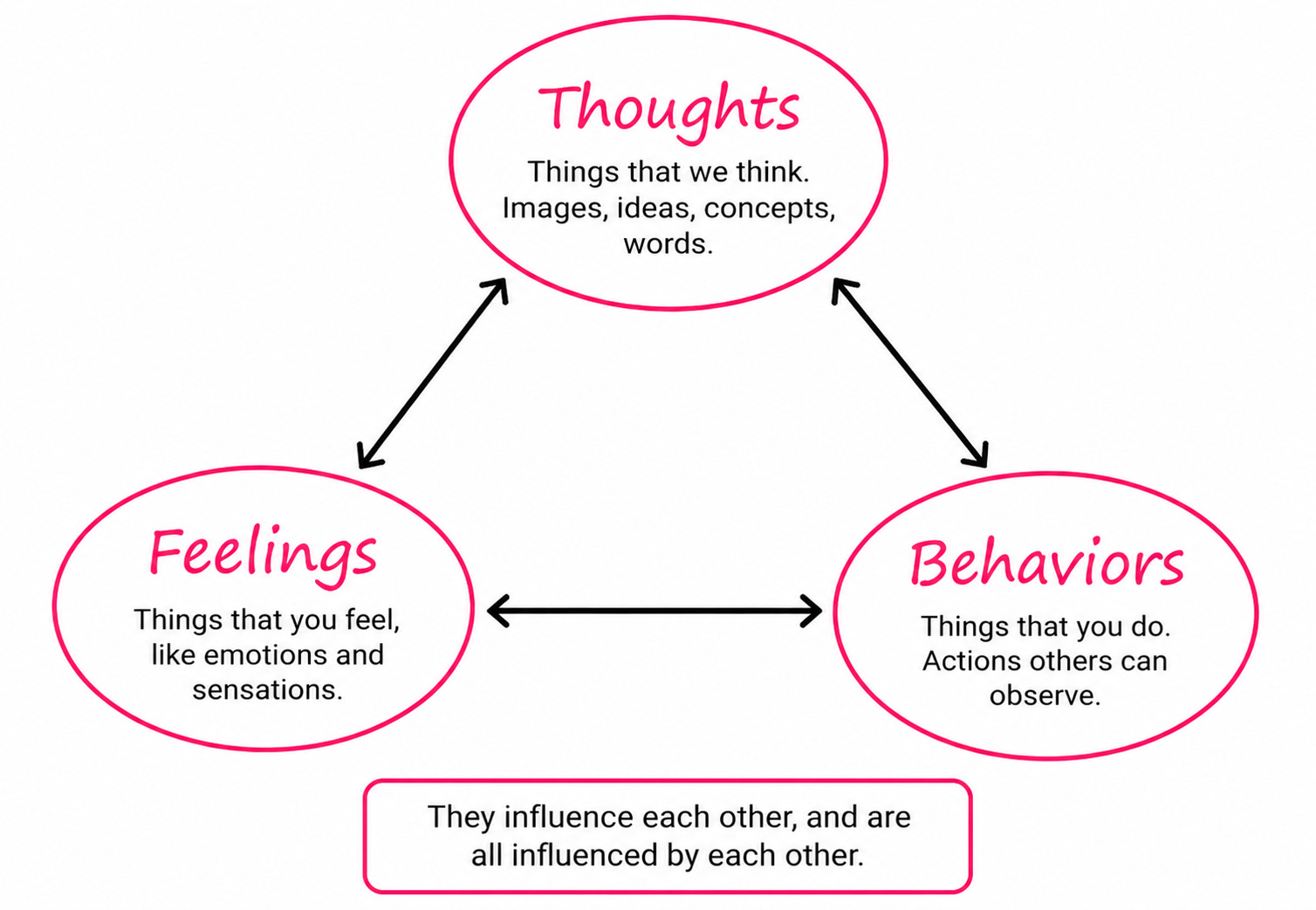
Psychology 101: Thoughts are things that we think. Images, Ideas, concepts, words. How you talk to yourself about yourself and the world, ideas you have, these are all thoughts. Behaviours are things that you do. Think of an action as something someone else can observe about you – running, sleeping, walking, talking, writing, etc. If it can be outwardly observed, it is an action. Feelings are things that you feel, like emotions and sensations. For example, stress, fatigue, sadness. You may have certain thoughts associated with your feelings and behaviours, but they are different things. Being able to identify and name them separately has great value. They are all influenced by and influence each other, and while directly changing a feeling is not usually possible or easy, we can influence feelings through things we can control like behaviours and attention given to thoughts (more on this below).
Remember: Not All Thoughts Are Facts
The typical person has over six thousand thoughts each day which can include ideas, judgments, memories, images and anything else our imagination can conceive. While it seems like stating the obvious, it is still worth saying: Not all thoughts are facts, some thoughts are just… thoughts.
If I imagine a purple flying elephant, this is a real thought, but the thought is not an objective truth about my current reality. Often, we treat our own thoughts as if they are truths or facts, when they are not. While a thought is real and worth noting, not every thought deserves the same attention and weight. Some thoughts are driven by emotions like fear or sadness, separating the feeling from the thought as well as noting which thoughts are objectively true vs which are assumptions, fears, or otherwise is important in effectively navigating the world around us.
Manage Pain and Reduce Suffering
There is a concept in mindfulness practice that identifies pain versus suffering; pain involves the inevitable hardships we all face in life, while suffering relates to how we manage (or mismanage) pain. According to this mindfulness concept – pain is inevitable, suffering is optional. Knowing the difference is important.
If you don’t expect setbacks, they will always catch you off-guard. While we can’t always predict what, when, and how they will show up, the thing we know is that the unexpected will happen.
When we face a pain - such as an injury, or even a death or other kind of loss – it helps to acknowledge it and allow space for the emotions and discomfort that come with it. However, as we move through our pain, we have some choice as to how we respond, including how we talk to ourselves. While thoughts may pop into our mind that are unwanted, we can notice and direct our attention and actions in a way that is constructive vs destructive. For example, I’m such an idiot for letting this happen versus This is hard and frustrating. I wonder why this happened? are two ways of responding to unwanted pain. One is blaming and judgemental, the other honest, compassionate, and curious. By focusing on managing our inner narrative in this way we can reduce suffering and better manage the pain we are dealing with.
Practice Hopeful Pragmatism vs Blind Optimism
Naming and acknowledging struggle is important in healthy coping. To learn, to grow, to move through pain and difficult emotions, we need to name them, feel them, validate what is difficult, get curious about it and learn how to work with it. This allows us to move forward. To say it is all going to be fine or you’re doing great when clearly, you’re not, is not helpful and even hurtful. Acceptance of a problem doesn’t mean passive submission to it, on the contrary, we must name it to manage it and move through it.
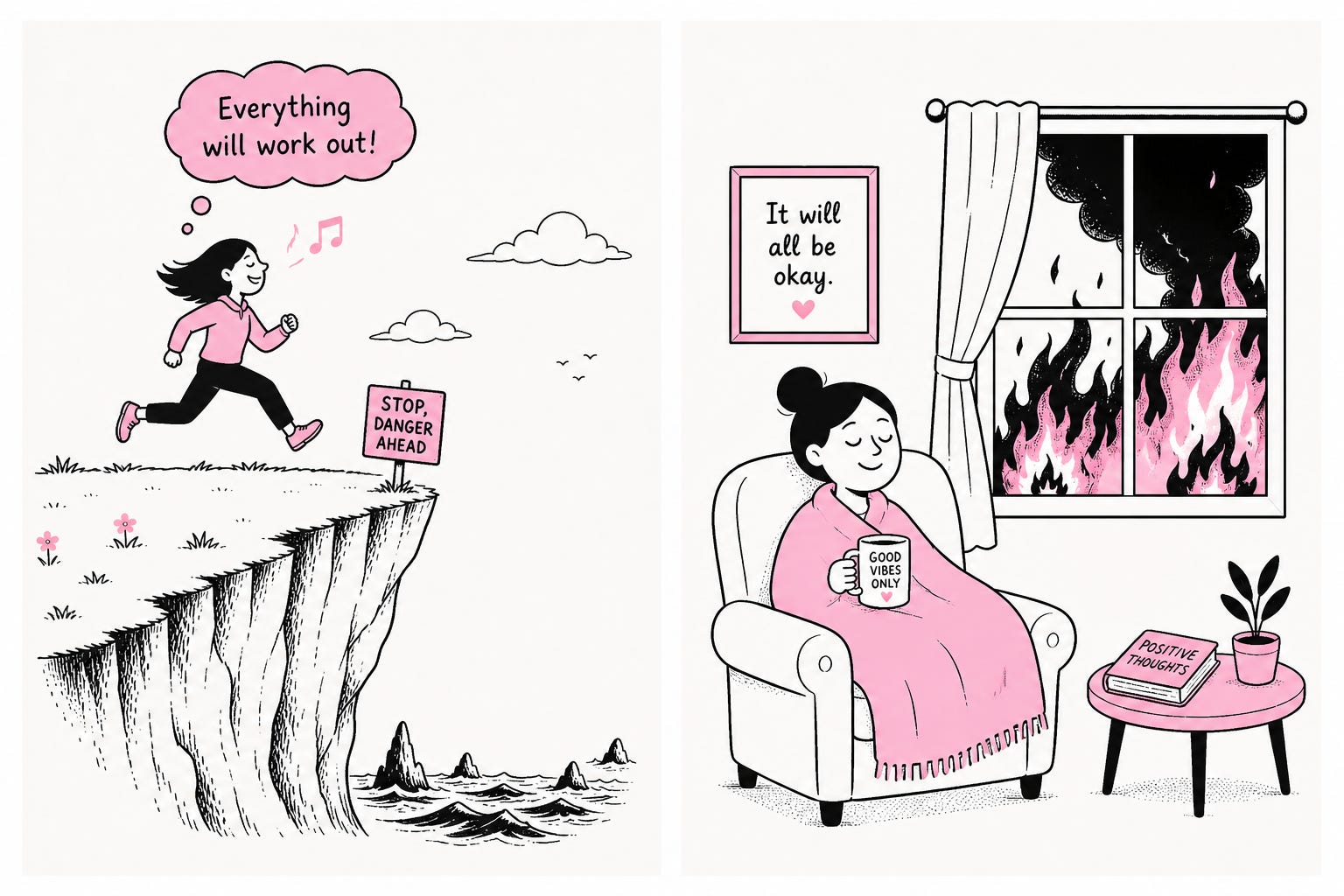
A few years ago, I was pacing a friend once in a one-hundred-mile race and she was not having her best day, struggling with the heat and some digestion issues that were slowing her down. Her coach, who had been largely absent, popped in at mile sixty and enthusiastically told her, “You’re doing awesome!” While meant to be encouraging, this comment was clearly demotivating for my friend. It was disconnected from, and invalidating of, her current reality. Perhaps a more helpful way of supporting her would have been to acknowledge her pain and express empathy for it while offering specific strategies, along with support and motivation regarding her awesome character, show of resilience, and focusing what she still has control over. Or, perhaps bringing levity by using humor, and offering perspective through acknowledging where the race sits in her broader life picture and identity. Lying to someone else, or ourselves, in a way that ignores the problem is less helpful than acknowledging the problem and working with it.

Name Your Emotions
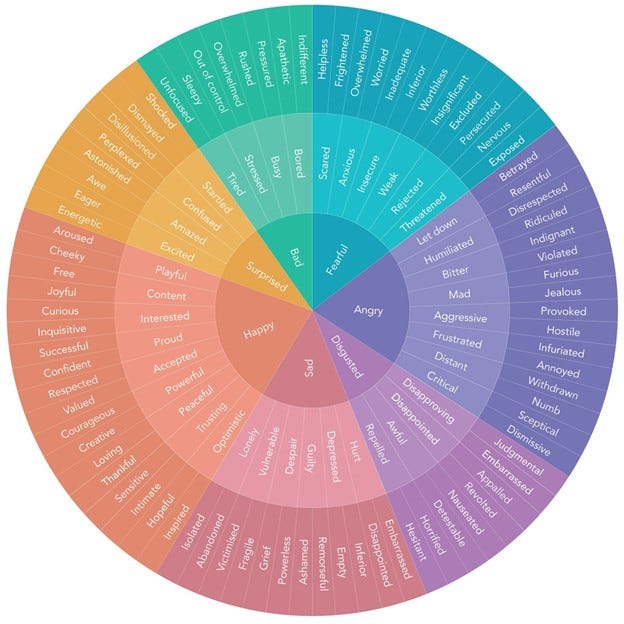
Building your vocabulary as a child helps you to express yourself and think in a more complex way which, in turn, enables you to interact with others and the world more meaningfully. In the same way, building your emotional vocabulary helps you do the same thing with your emotions. The better we can name our feelings and articulate emotions, the better we can be at placing them in relation to our experiences. This helps us to get perspective on where they come from and what to do with them when they show up.
As humans we are meant to experience a broad range of emotions, not only the “good ones”. For example, imagine a feeling of anxiety (pounding heart, rapid breathing, uneasiness in your stomach, racing thoughts) is kind of like your body’s smoke alarm going off. This alarm is meant to get our attention. We need to recognize what it is and respond to it. It is loud and uncomfortable, but it is that way for a reason – potentially saving us from a fire. Once we recognize the smoke alarm is going off, we might then want to assess the environment for smoke, for a fire. Our response might be very different if we see flames vs notice the battery is low. Some people have extra-sensitive smoke detectors, knowing this can also help with how to respond when it goes off and how to manage it. Our emotions are internal signals about the world and give us important information which helps us navigate our environment more effectively.
Engage in Curiosity vs Judgment
Much of our distress can come from jumping to judgements and conclusions while skipping over the task of just observing and noticing. For example, you didn’t perform as you’d hoped to at a race, you will gain more from noticing what went wrong vs blaming yourself if you adopt a curious, observational mindset.
Imagine a person doing scientific research, this scientist may have a hypothesis (a theory or idea) but then they do an experiment to see if their theory is correct. This is how we want to approach our performance - try a certain training or studying method, have a hypothesis as to how that will affect out behaviour and performance. Of course, if our expectations aren’t met, we will likely have some negative emotions (refer back to the above Emotions Wheel), but we can hold space for these emotions without letting them dictate our thoughts and self talk. The best way to manage this is through curiosity.
If you notice yourself judging or blaming yourself, try reframing your statement into a genuine question and answering it. Even getting curious about the emotions you name can help give you some important information about how to recover, get a different perspective, and move forward!
Be Present: Manage Mental Time Travel
The only moment we truly have control over is the one we are in: the present moment. It is where we have the power to change. Mentally, our mind often zooms between the past and the future and while there is function to this “mental time travel”, staying too long, with the wrong lens, in either place can be unhelpful and even harmful.
We are meant to think about the past so that we can gain insight, learn, reflect on what happened to help us grow. If our mind starts to linger and play the blame-game or ruminate vs get curious, we tend to spiral downward, emotionally and mentally, fixating on what has already happened, feeling helpless about what we cannot change it. Putting labels or judgements like that was bad and stopping there without getting curious (i.e. what was bad about this?) is where we truly kick ourselves down. Having empathy, getting curious, these are the dispositions that can be more helpful when we consider the past.
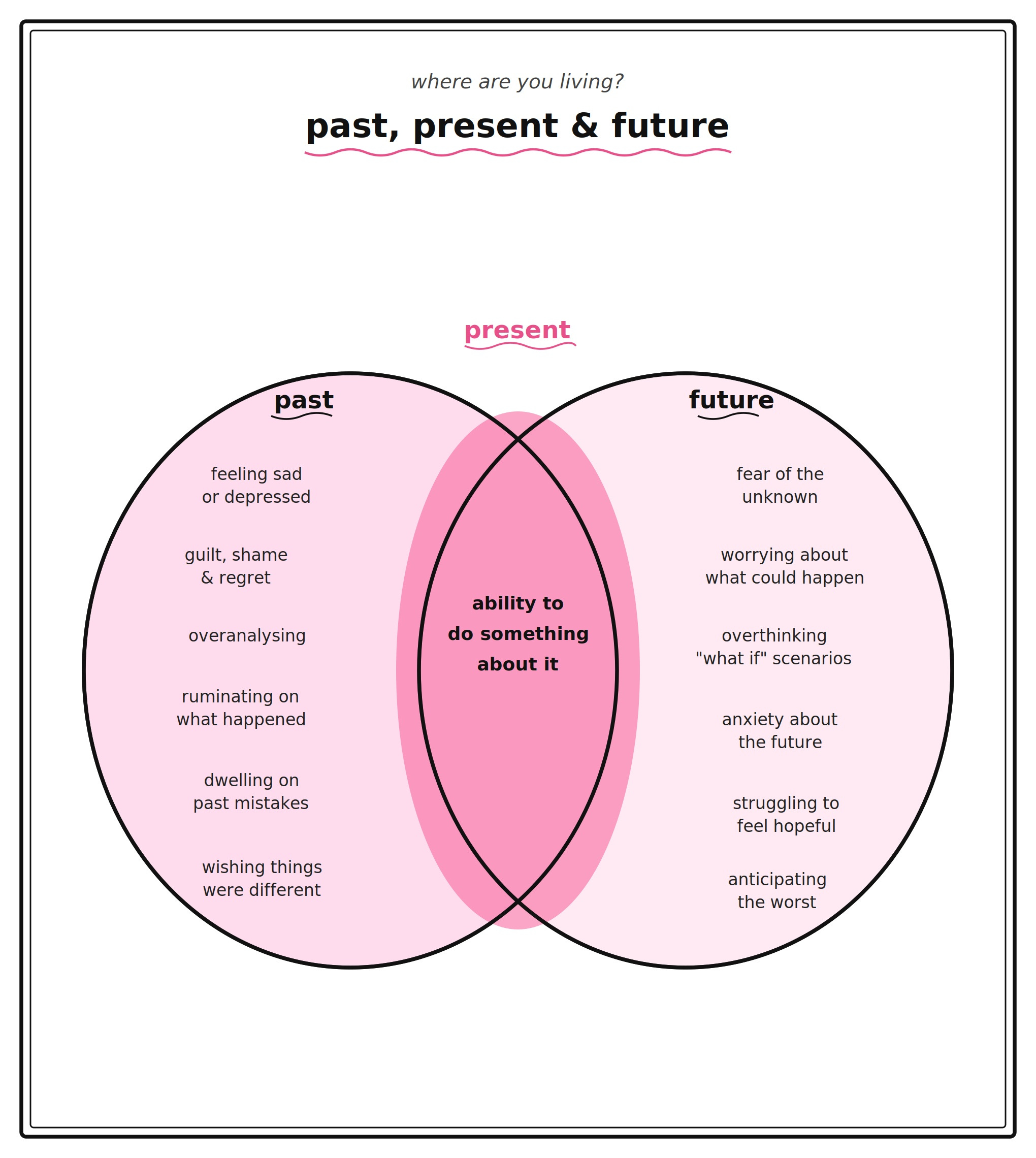
When our mind wanders to the future it can be helpful in setting goals and considering what we aspire to (or hope to avoid), which is important in motivation. Knowing where you want to go, and where you do not want to go (i.e. approach and avoidance theory) is important.
Imagine you are planning a road trip, it is helpful to know your destination as it will dictate the turns you take, though thinking only about your destination, or the ditch you want to avoid driving your car into, won’t get you there (and more likely will leave you in the ditch). We can become anxious when we think about feared future consequences, or even idealized future goals, and don’t pair these thoughts with actions in the present moment. We can start to confuse fears for facts which can get in the way of moving towards out goals. For example, fearing I’ll fail an exam is different than studying for the exam. Aspiring to run a marathon is different than training for one.
We want to glance in the rear-view mirror, or peek ahead to our destination, but, ultimately, we want to spend our focus on immediate actions, in the present moment. When I find myself ruminating on the past or fixating on the future, I ask myself: what can I do about that right now? It helps me reframe the past and future in terms of actions to grow and move toward/away from whatever is on my mind.
Plan for Disruptions
If you don’t expect setbacks, they will always catch you off-guard. While we can’t always predict what, when, and how they will show up, the thing we know is that the unexpected will happen. Sometimes we can predict them (ex. knowing a hilly section of climb in a race course will be the hardest part) and in these cases we can’t avoid but we can prepare ourselves for managing it well. This plan might include pacing, fueling, effort but also how we want to talk to yourself, anticipating certain negative thoughts and how we want to react to those thoughts in advance.
If we don’t create space and a framework for setbacks, we tend to just react - meaning whatever emotion we feel is often in the driver’s seat and we do what feels impulsively good in the moment. This can be highly destructive for you and your goals outside of the moment (i.e. the runner that misses a turn on course and quits due to being off her planned pace).
Alternatively, responding involves planning for setbacks and creating a framework for how we want to manage it which usually includes staying grounded in our values and goals even when upset. For example, taking a deep breath, counting to three, naming an emotion, asking: what can I do about that right now? can be useful in any stressful situation.
Managing Expectations and Perfectionism
Most suffering comes from unmet expectations, or put another way: expectations minus reality. How we wanted it to be versus how it actually is. When we look at what is within our control, we might point to effort but often forget that we have the power to adjust our expectations as well.
One mistake I see many people make is they aim too high too fast. Perfectionism is the enemy of progress. Sometimes breaking down an expectation to something smaller to start helps us move, and movement sparks motivation, motivation sparks more movement. The more we move the higher we can reset our expectations, keeping the gap between our reality and where we want to be at just the right distance that we can see a pathway connecting the two.
Perfectionism is the enemy of progress.
This doesn’t mean we need to totally let go of big aspirations or goals, but we do need to know how to break those goals down into milestones and acknowledge when the big goal is hurting vs helping us make progress.
Be Your Own Friend
Learning to be friends with yourself is one of the best things you can do it life. It makes alone time more enjoyable and also helps us keep integrity in our friendships. If you wouldn’t talk that way to a friend, you shouldn’t talk that way to yourself, and vice versa. Research tells us that talking to ourselves in third person (i.e. “Cassie” vs “I” or “me”) helps us to be more objective and get a clearer perspective when problem solving.
One Last Thought
Life is one big experiment and the more we try the more we gain info about what does and doesn’t work for us. Whatever you are pursuing, don’t take it so seriously that you can’t laugh at yourself, stop and admire moments of beauty and awe, and have gratitude for the community around you that lifts you up (you have one even if you don’t know it). Behind any great performance is a human who is doing their best given what they have to work with.